
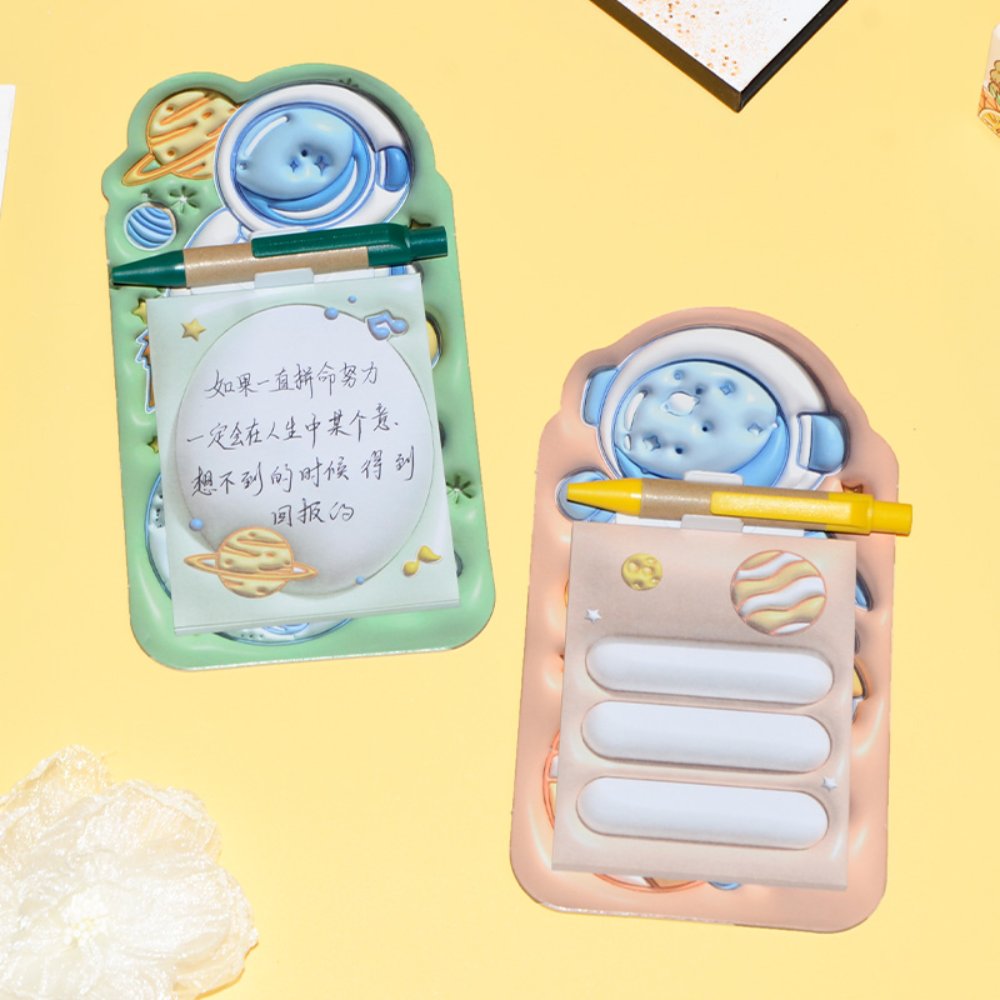
For a magnetic memo pad order, identify the note-face layout separately from the decorated holder. Ask which elements are supplied as print, which spaces are intended for writing and whether visible words are demonstration content. Retain an identified face reference with the offer. A styled photograph does not establish the exact printed page supplied.
Identify the note face separately from the holder
A buyer researching wholesale sticky notes may select a magnetic memo pad by its decorated holder, then discover that the note face still needs clarification. The holder’s appearance does not establish the printed layout of the paper in front of it. Treat those as separate references in the enquiry.
The Qihuan Magnetic Notes listing uses blank, lined and grid wording alongside shaped-base descriptions. Its catalogue images show different note-face arrangements. These references support a layout discussion, but they do not establish which exact page is offered or whether every visible word will be supplied as print.
Ask what is printed and what is demonstration content
A styled memo-pad photograph can contain a message, a decorative border and open spaces. Ask the supplier which elements belong to the supplied printed face and which are demonstration content. Do not assume that a handwriting-like message is printed, or that it was added by a user, without an actual answer.
A focused question could say: “Please identify the note-face layout offered under this quotation line. Mark the supplied printed elements and distinguish any example writing shown in the catalogue.” This gives the supplier a concrete image to explain rather than asking only whether the design is the same.
Keep the original image with that response. A marked copy may help identify a border, line group or text area, but the buyer’s annotations should be recognizable as annotations. They should not look like original supplier artwork or imply that the supplier has accepted a modified design.
Define the functional layout without inventing dimensions
Describe the arrangement the buyer needs to understand: an open message area, a lined face, a grid or another supplier-identified structure. These are layout descriptions, not proof that every format is currently offered. Ask the supplier to identify the available proposal for the enquiry and connect it to a clear face reference.
Where field names or repeated writing spaces matter, list them explicitly and ask what the supplier’s proposed page contains. Do not estimate writable-area dimensions from a photograph or infer the arrangement of unseen pages. This enquiry concerns the visible content and structure of the offered face, not a physical-size or sheet-count specification.
Layout field | Question for the supplier | Reference to retain
Note-face identity | Which face is proposed for this offer? | Supplier identification and a marked catalogue or artwork reference.
Printed content | Which words, lines and decorative elements are supplied as print? | Supplier’s content explanation.
Demonstration text | Which visible words are examples rather than supplied content? | The original image and its clarification.
Writing-space structure | What open, lined, grid or field arrangement is proposed? | An identified face view without inferred dimensions.
Offer connection | Which quotation line and revision does the face reference cover? | The dated response and decision status.
Clarify orientation and unseen page content
Ask the supplier to identify the top of the proposed face in its intended assembled orientation. A loose page can be photographed in a way that makes a field arrangement look different from the assembled reference. A clearly marked orientation helps the purchasing team discuss the same layout without guessing from the holder’s decorative outline.
If the buyer needs to know whether the face repeats through the pad or whether there is a page sequence, ask that question directly. A front photograph does not establish unseen content. Keep the supplier’s actual response with the layout reference rather than assuming every page follows the first visible face.
This does not establish a replacement-pad interface. A confirmed printed layout does not prove that a refill fits or is retained by a particular holder. That mechanical relationship is a separate procurement question, even when the same catalogue photograph is used to locate both components.
Keep proposed artwork distinct from an available product
A buyer may want different wording or a different field structure. Present that as a request and ask whether the supplier can propose a corresponding item or service. The catalogue examples do not, by themselves, establish custom printing availability, accepted artwork requirements or commercial terms.
If the supplier provides a proposed proof, give it an identifiable revision and retain the decision made on it. Approval of one layout should state what content was accepted. It should not silently approve a new holder, material, page count or other product specification that the proof does not establish.
• Keep the holder reference separate from the note-face reference.
• Ask the supplier to distinguish print from demonstration writing.
• Identify the proposed face orientation and any stated page sequence.
• Retain requests, supplier proposals and accepted revisions as different statuses.
When an offer changes the face reference, ask what printed elements or field arrangements change. A similar colour or decorated holder is not enough to establish an unchanged page. The relevant comparison is the identified layout and supplier explanation attached to the current offer.
Magnetic memo-pad layout questions
Is every word in the photograph supplied as print? The photograph alone does not establish that. Ask the supplier to separate supplied printed content from demonstration writing.
Does a lined catalogue example establish every page in a pad? No. Request the proposed face and any page-sequence information that matters to the enquiry.
Does confirming the layout confirm refill compatibility? No. The printed face and the holder’s retaining interface are separate specifications.
Can a buyer assume custom wording is available? No service availability is established by these catalogue examples. Send a specific request and retain the supplier’s actual proposal.
Send an identified face reference with the enquiry
Use the contact page to ask which note face and printed elements the supplier proposes. The catalogue and blog provide further stationery context. An explicit layout answer gives the buyer a usable content reference without relying on a styled photograph to define the supplied page.
Product and contact references
https://qhstationery.com/product/magnetic-notes/
https://qhstationery.com/contact/
https://qhstationery.com/products/
https://qhstationery.com/blog/